Simultaneous Equations Calculator Solve Systems with 2, 3, 4, or 5 Variables – Step-by-Step Solutions
Want to calculate? Get Solutions Here:
To calculate with the Simultanous Eqtn Solver
Enter Pairs or equations above separated Either ',' OR a ';' eg. x^2-y^2=4,2x-y=9 OR x^2-y^2=4,2x-y=9 Click the button to Solve!
Simultanous Quadratic Equations Examples with Solutions
Graphical Solution of Equations:
Online System of Equations Calculator with Step-by-Step Solutions
Our simultaneous equations calculator is a powerful online tool designed to solve systems of equations quickly and accurately. It provides detailed step-by-step solutions, making it easy to understand every stage of the calculation process.
This advanced system of equations solver can solve both linear and non-linear equations involving 2, 3, 4, or 5 unknown variables. Whether you are solving equations for school, college, engineering, physics, or algebra practice, this calculator helps you find accurate solutions instantly.
The calculator supports equations with variables such as x, y, z, n, and m. It can solve systems containing linear equations, quadratic equations, and other algebraic expressions while showing all intermediate steps clearly.
Use this online simultaneous equations solver to:
- Solve systems of linear equations online
- Find unknown variables quickly and accurately
- View detailed step-by-step workings and explanations
- Solve equations with 2, 3, 4, or 5 variables
- Check homework, assignments, and algebra problems
A common example is solving a system of 3 linear equations with 3 unknowns such as x, y, and z. This calculator solves such problems systematically using proven algebraic methods to provide clear and accurate answers.
A linear equation represents the relationship between two or more variables. Linear relationships are widely used in mathematics, science, engineering, economics, and everyday problem-solving because many real-world situations can be modeled using straight-line relationships.
A standard linear equation is written in the form
ax + by = c.
Such an equation has infinitely many solutions because there are many values of
x and
y that satisfy it. To determine unique values for the unknown variables, you need additional equations. This is the foundation of simultaneous linear equations.
In general, you need
n independent equations to solve for
n unknown variables.
Our online system of linear equations calculator helps you solve simultaneous equations quickly and accurately. The calculator provides detailed step-by-step solutions, showing every stage of the calculation process clearly. Whether you are solving algebra homework, checking answers, or studying mathematics, this tool makes solving systems of equations simple and reliable.
This simultaneous equations solver supports systems with 2, 3, 4, or 5 unknowns and can solve both linear and non-linear equations. It is fast, accurate, user-friendly, and designed for students, teachers, engineers, and anyone working with algebraic equations.
Before learning how the linear simultaneous equations calculator works, it is important to understand the basics of a system of linear equations and how their solutions are determined.
Finding the Solution of a System of Linear Equations
A solution to a system of linear equations is a set of values that satisfies all equations in the system at the same time.
For a two-variable system, the solution represents a point in a two-dimensional coordinate plane where the graphs of the equations intersect. In a three-variable system, the solution represents a point in three-dimensional space that satisfies all equations simultaneously.
Similarly, systems with higher numbers of variables follow the same principle, where the solution is the set of coordinates that satisfies every equation in the system.
A System of Linear Equations May Have:
- One unique solution — the equations intersect at exactly one point.
- Infinitely many solutions — the equations represent the same line or plane.
- No solution — the equations are inconsistent and never intersect.
Solving Systems of Equations Online
When Does a System of Linear Equations Have a Unique Solution?
For any non-homogeneous system of linear equations, a unique solution exists if and only if the determinant of the coefficient matrix is non-zero. When the determinant equals zero, the system may either have infinitely many solutions or no solution at all, depending on the equations involved.
For a system with two unknown variables, you need at least two independent equations to determine the solution uniquely. When graphed on a two-dimensional coordinate plane, each equation represents a straight line. The solution to the system is the point where the two lines intersect.
If the lines never intersect, the system has no solution because the lines are parallel. Such a system is called an inconsistent system of equations.
Example:
In this example, the two equations represent parallel lines. Since parallel lines never meet, the system has no solution.
For systems with three variables, the equations represent planes in three-dimensional space. A system may have:
- A unique solution where all planes intersect at one point
- No solution when the planes are parallel or inconsistent
- Infinitely many solutions when the planes overlap
A system of linear equations has infinitely many solutions when the equations represent the same line in two dimensions or the same plane in three dimensions.
Solve Simultaneous Equations Calculator
Our online simultaneous equations calculator helps you solve systems of equations instantly. The calculator provides detailed step-by-step explanations, making it easy to understand the solving process and verify your answers.
Use this system of equations solver to solve linear and non-linear equations with 2, 3, 4, or 5 unknown variables quickly and accurately. Below are worked examples showing how to solve simultaneous equations step by step.
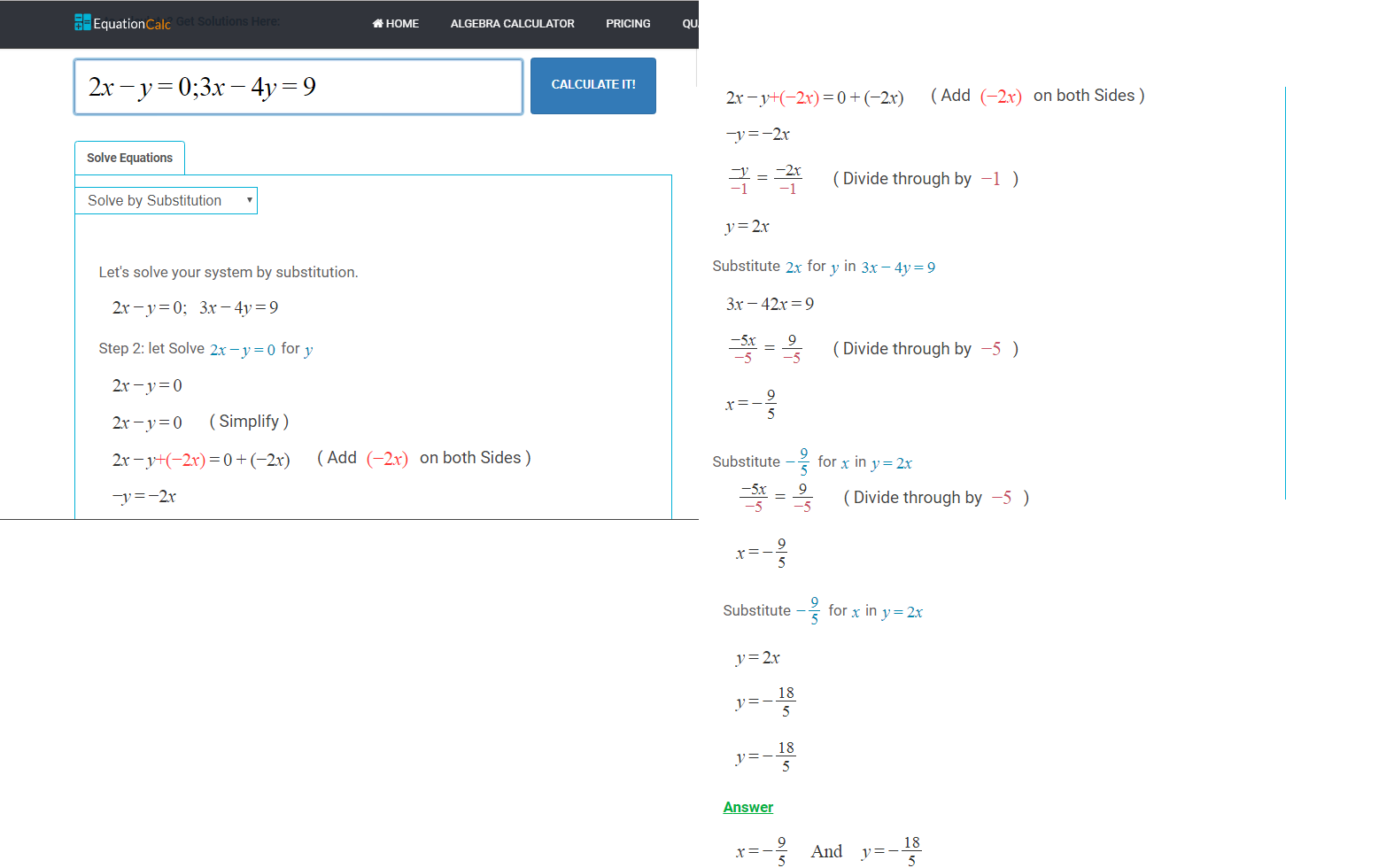
With our simultaneous equations calculator, you can solve complex systems of equations quickly and accurately. The calculator displays all the working steps clearly, making it an excellent learning tool for students studying algebra and linear equations.
This online system of equations solver helps you perform calculations faster while improving your understanding of how simultaneous equations are solved step by step.
How to Solve a System of Linear Equations
For a two-variable system, there are typically two equations with two unknowns. Several methods can be used to solve such systems, with the most common being the Substitution Method and the Elimination Method.
Substitution Method Calculator
The substitution method involves solving one equation for a single variable and then substituting that expression into the second equation. This reduces the system to one equation with one unknown, making it easier to solve.
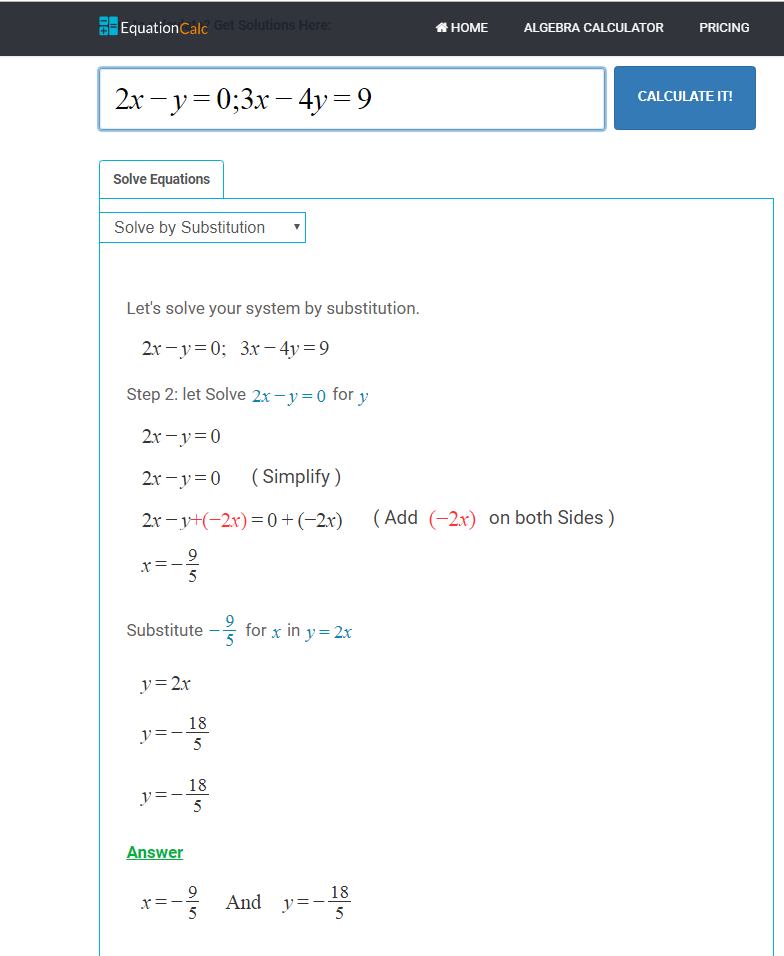
Our algebra calculator includes a dedicated substitution method calculator that helps you solve simultaneous equations step by step using the substitution technique. The calculator shows all intermediate steps clearly, making it ideal for learning and checking homework solutions.
Substitution Method Calculator Examples
Elimination Method Calculator with Workings
With our online algebra calculator, you can solve systems of linear equations using the elimination method quickly and accurately.
This simultaneous equations solver is free, efficient, and designed to show clear step-by-step working. The elimination method is one of the most commonly used techniques for solving linear systems.
For a two-variable system, the process begins by selecting a variable to eliminate, allowing the equations to be simplified into a single equation with one unknown. This makes it easier to find the final solution step by step.
Let’s assume the system is expressed in x and y coordinates. For simplicity, we begin by eliminating x.
First, identify suitable multipliers that make the coefficients of x in both equations equal. This step allows both equations to be aligned so that one variable can be eliminated easily.
Multiplying an equation by a constant (scalar) does not change the validity of the equation. After adjusting the equations, subtract one equation from the other to eliminate x, leaving a single equation with only one unknown.
Once reduced to a single-variable equation, it becomes straightforward to solve. After finding the value of x, substitute it back into either of the original equations to determine the value of y.
Here are worked examples demonstrating how to solve systems of equations using the elimination method.
Quadratic Simultaneous Equations Calculator with Step-by-Step Working
This calculator also solves systems involving a combination of quadratic and linear equations. In a two-dimensional case, the solutions represent the points of intersection between curves. In more complex systems, the solutions may also include complex or non-real values depending on the nature of the equations.
Common examples include simultaneous equations involving squares, such as: x^2 + y^2 = 2; x + y = 1
For step-by-step solutions of any system of equations, an online algebra calculator provides the simplest and most efficient approach. When variables can be separated or factored, many systems can still be solved using substitution or elimination methods. This makes the simultaneous equations calculator fast, reliable, and highly effective for learning and problem-solving.
How to Use the Simultaneous Equations Calculator Online
Before using the solver, first ensure your problem is supported. The calculator currently handles linear systems with 2, 3, 4, 5, 6, or 7 unknowns, as well as mixed quadratic and linear systems and other non-linear equations. Future updates will expand support for even more complex systems.
- Enter your equations separated by ; or ,, then click the calculate button to get an instant solution.
- Scroll down to view the full step-by-step working and explanation.
- You can also print the solution using the “Print Solution” option.
If you find our system of equations calculator useful, or have suggestions for new features, feel free to contact us via email. We are always improving the tool based on user feedback.
Share this simultaneous equations calculator with friends, classmates, and colleagues to help others solve equations faster and easier. You can copy and share the link through social media.
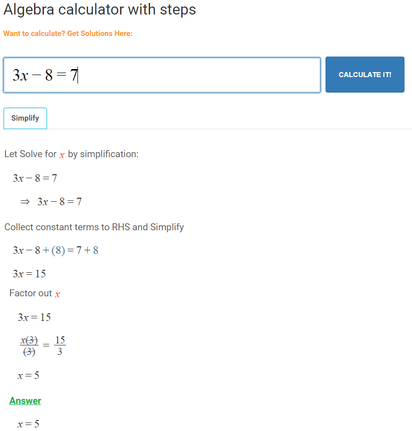
Here is a Worked example to illustrate how the simultanous calculator Works:
Learn how to solve simultanous equations algebraically with Examples
Perhaps it is best if you learnt math through examples. Checkout our algebra examples, each with a step by step solution. The Examples will also guide you on how to use this equation calculator to solve your algebra problems.
Go to Solved Algebra examples with Steps
Acceptable Math symbols and their usage If you choose to write your mathematical statements, here is a list of acceptable math symbols and operators.
- + Used for Addition
- -Used for Subtraction
- *multiplication operator symbol
- /Division operator
- ^Used for exponent or to Raise to Power
- sqrtSquare root operator
What’s more or what are the limitations of the online algebra calculator
We love to hear your feedback. If you encounter any problems while using this calculator, please let us know: Want to see more features? Send us your recommendations and app ideas. We are always working hard to make algebra easy and fun.